Metal Roof Cost in Sacramento and Placer County (2026): Standing Seam, Metal Shingles and Exposed Fastener
By Justen Pressler |
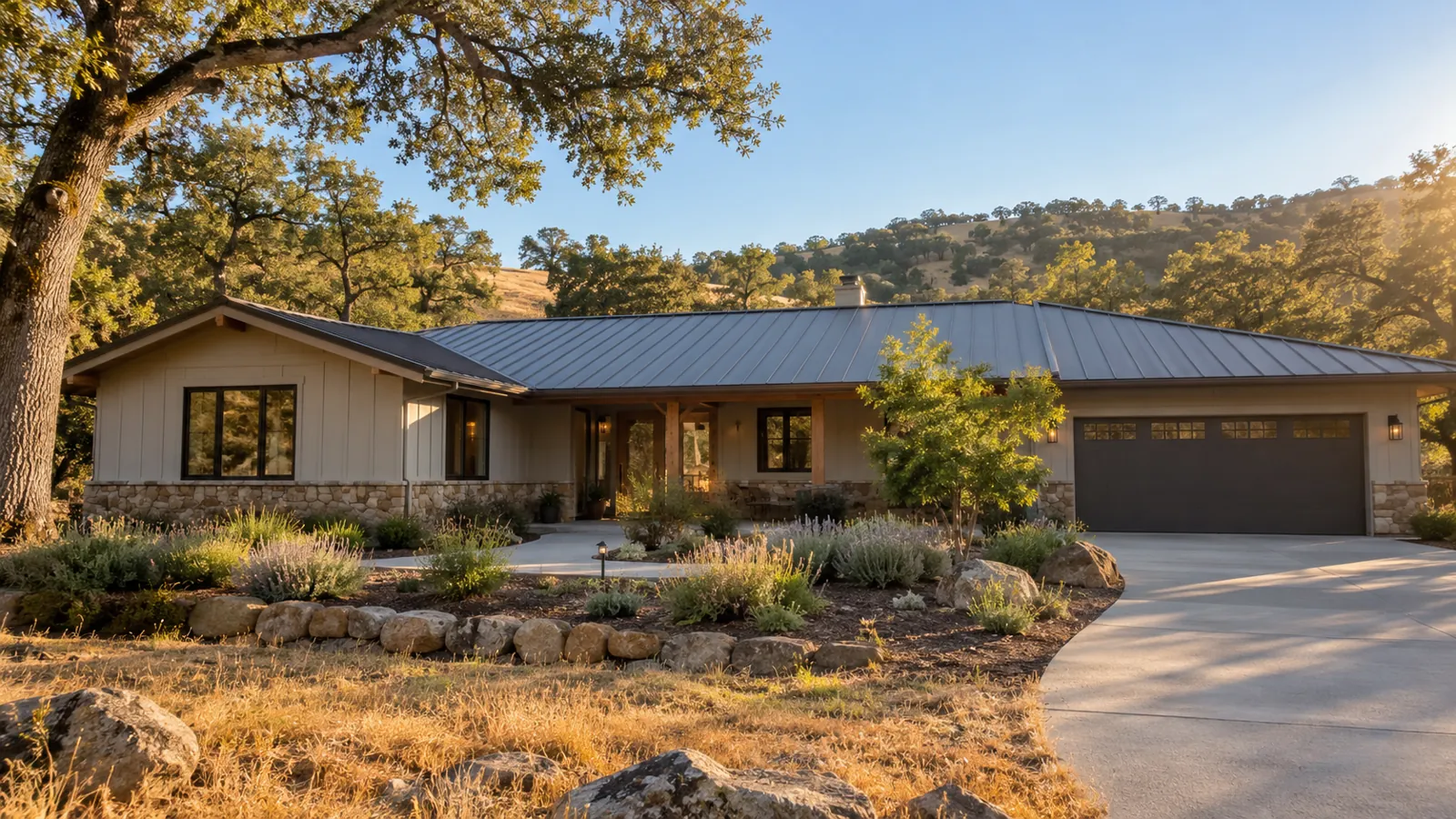
A metal roof is not one product. "Metal roofing" covers concealed-fastener standing seam, exposed-fastener panels, stamped metal shingles and stone-coated steel, and their installed prices can be thousands of dollars apart on the same house. If you are pricing a metal roof in Sacramento or Placer County, the most useful first question is not "how much per square foot?" It is "which system, which metal and finish, and what is included underneath it?"
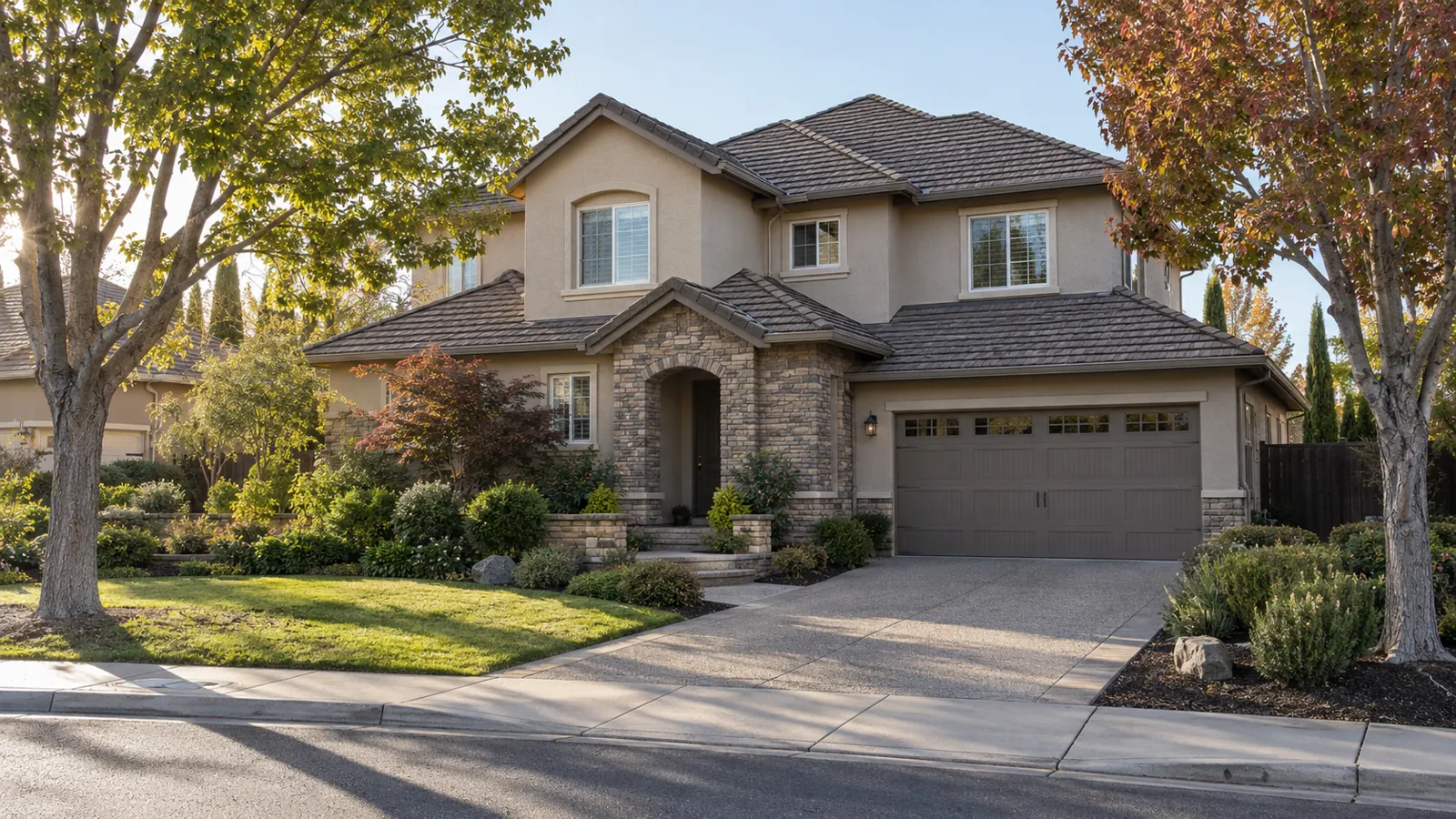
I wrote this for homeowners comparing a metal roof against a conventional shingle replacement on a typical steep-slope home. Low-slope roofs, commercial roofing and red iron steel buildings are different assemblies and are not covered here. The cost figures below come from the published sources linked in each section, not from Pressler bids. Your own price depends on your roof, so treat these as a starting range. The photographs are illustrative and do not show Pressler projects. If you want to compare metal to tile and asphalt more broadly, read our tile vs shingle vs metal roofing comparison first.
The Short Answer: What Does a Metal Roof Cost?
- Published 2026 national installed ranges from HomeGuide's metal roof cost guide: standing seam $9 to $16 per square foot, metal shingles $6 to $14, and corrugated or standard sheet metal $5 to $12. HomeGuide's stone-coated steel guide lists $7 to $13 per square foot.
- Sacramento data point: the 2025 Cost vs. Value report for Sacramento puts its metal roof replacement project at $54,356, compared with $31,775 for its asphalt shingle replacement project.
- Resale is not the reason to choose metal. In that same Sacramento report, the metal project recouped an estimated 54.2 percent of its cost at resale, versus 80.2 percent for asphalt.
- What moves the price most: panel system, gauge and metal type, paint finish, roof complexity (valleys, hips, dormers, penetrations), tear-off and decking repair, underlayment, flashing and trim, and any solar detach and reset.
- What to ask for: a written scope that names the panel profile, gauge, finish, underlayment, fastening method and every flashing detail, not just "metal roof."
How to Read a Price Per Square Foot
Roofers price by roof area, not house size. A "square" is 100 square feet of roof surface, so $9 to $16 per square foot is $900 to $1,600 per square. A 2,000 square foot single-story home can easily have 2,400 to 2,800 square feet of roof once pitch, overhangs and garage are counted. Ask how the roof was measured and how many squares the proposal assumes. If two bids are thousands of dollars apart, compare the measured area before comparing anything else.
Published ranges are also national. Labor rates, permit fees and disposal costs in the Sacramento region tend to sit above national averages, and a cut-up roof with many valleys and penetrations costs more per square foot than a simple gable. That is why the Sacramento Cost vs. Value figure is higher than a national square-foot range would suggest for an average house.
The Four Common Residential Metal Roof Systems
Standing seam (concealed fastener)
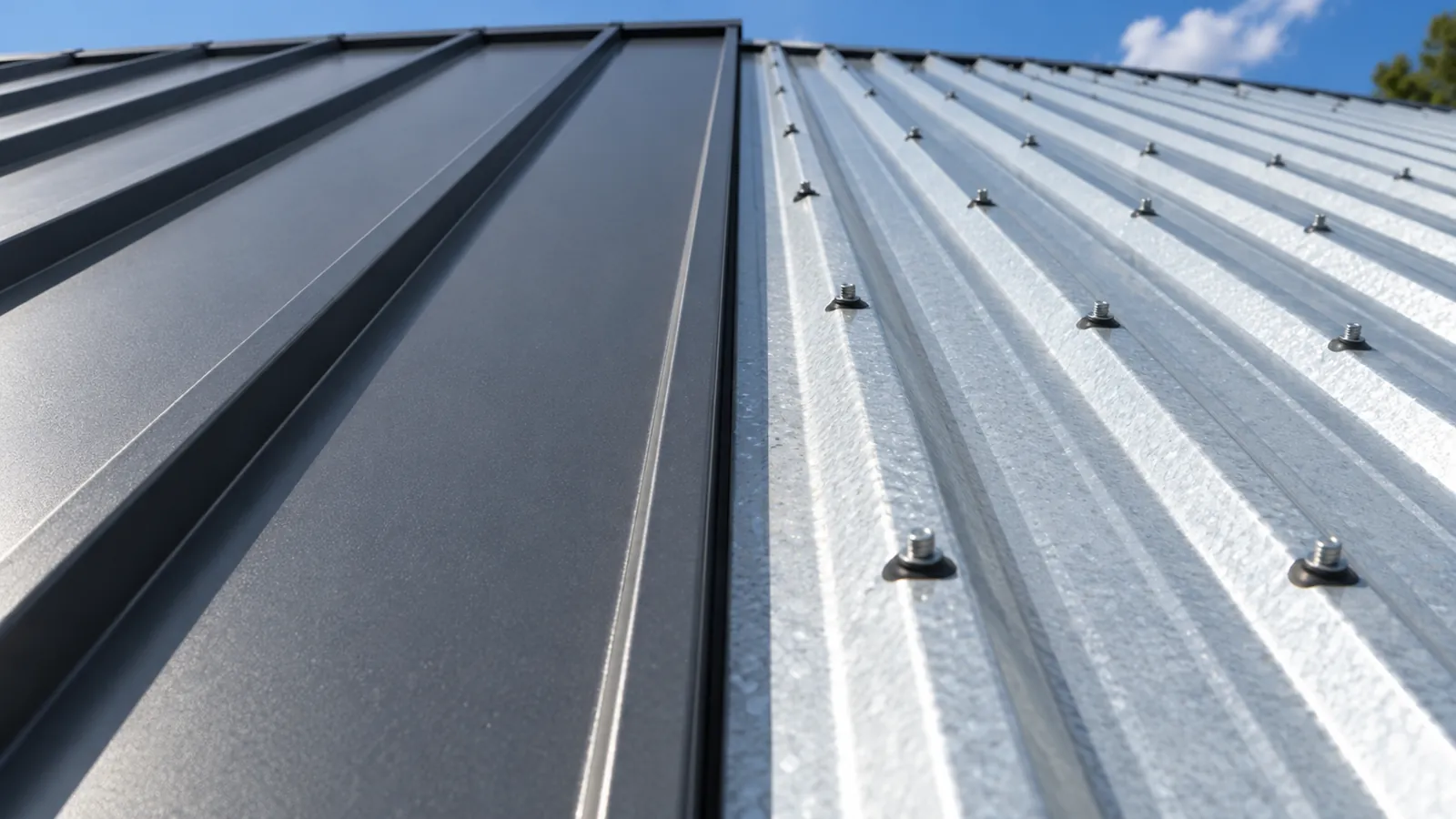
Standing seam panels run from eave to ridge and lock together at raised seams. Clips attached to the deck hold the panels while letting them expand and contract, so there are no exposed screws through the weather surface. This is the system most homeowners picture when they say "metal roof," and it is usually the most expensive of the four. HomeGuide lists $9 to $16 per square foot installed.
Two details are worth asking about. First, panel width and stiffening: wide, flat panels can show oil canning, a visible waviness in the flat of the panel. Sheffield Metals describes oil canning as a cosmetic issue rather than a structural one, typically excluded from warranties, and reduced by striations or ribs in the panel, heavier gauge, narrower panels and a flat deck. Second, whether panels are roll-formed on site or delivered pre-cut, and how long runs and transitions will be handled.
Exposed-fastener panels (corrugated, R-panel)
Exposed-fastener panels are screwed directly through the panel face with gasketed screws. They cost less (HomeGuide lists $5 to $12 per square foot for corrugated and standard sheet metal) and install faster, which is why they are common on barns, shops and agricultural buildings. On a home, the trade-off is maintenance: every screw is a penetration, and the rubber washers age in the sun. Ask how many fasteners the system uses, what the screw and washer warranty is, and whether the proposal includes a re-inspection or re-tightening schedule.
Metal shingles
Stamped metal shingles interlock in smaller units and can be formed to look like shake, slate or tile. They suit homes where a standing seam look does not fit the neighborhood or HOA guidelines. HomeGuide lists $6 to $14 per square foot installed.
Stone-coated steel
Stone-coated steel is steel panels with a bonded granule surface, profiled to look like architectural shingles, shake or tile. From the street it often reads as a conventional roof. HomeGuide's 2026 guide lists $7 to $13 per square foot, and $12,200 to $25,900 as a typical project range.
| System | Published installed range (per sq ft) | Fasteners | Typical fit |
|---|---|---|---|
| Standing seam | $9 to $16 | Concealed clips | Modern, farmhouse, foothill homes |
| Exposed fastener / corrugated | $5 to $12 | Exposed, gasketed screws | Shops, barns, simple roofs |
| Metal shingles | $6 to $14 | Concealed, interlocking | Homes needing a traditional look |
| Stone-coated steel | $7 to $13 | Varies by profile | Neighborhoods expecting a shingle or tile look |
*Ranges from HomeGuide's 2026 cost guides linked above. National figures; local bids vary.*
What Actually Drives a Metal Roof Bid
Metal, gauge and finish
Most residential steel panels use a Galvalume (aluminum-zinc coated) substrate. Sheffield Metals notes that Galvalume resists corrosion two to four times better than galvanized steel, and that aluminum is the usual choice in coastal salt air, which is not a typical concern in the Sacramento Valley. Heavier gauge (a lower number, such as 24 versus 26) costs more and resists denting and oil canning better. Paint matters as well. PVDF finishes (often sold under the Kynar 500 name) generally carry longer fade and chalk warranties than SMP finishes. Ask for the finish type and the length and terms of the paint warranty in writing.
Roof shape and penetrations
Every valley, hip, dormer, skylight, chimney and vent pipe needs custom flashing and trim. On a simple ranch roof, the panels are most of the cost. On a complex two-story roof with many penetrations, labor and trim can be a large share of it.
What is underneath
A metal roof is an assembly. The bid should say whether the old roofing is torn off, how much decking repair is allowed for, which underlayment is used and how ventilation will work. Our guide to attic ventilation before a roof replacement covers the intake and exhaust questions to ask. These apply to metal just as much as to shingles.
Solar
If you have rooftop solar, the panels must be removed and reinstalled, and mounts must be flashed for the new roof. Standing seam can use clamp-on attachments that grip the seam rather than penetrate the panel, but compatibility depends on the panel profile and the racking. Our roof replacement with solar panels guide explains the detach and reset process and how it is priced.
California Rules That Can Affect Your Metal Roof
Cool roof requirements (Title 24, Part 6)
California's 2025 Energy Code took effect January 1, 2026. According to the Cool Roof Rating Council's summary of the 2025 Energy Code, steep-slope reroofs on single-family homes in climate zones 4 and 8 through 15 must meet a minimum aged solar reflectance of 0.20 and thermal emittance of 0.75 (or an SRI of 16), unless an exception applies. One example is R-38 or more ceiling insulation. Sacramento is the representative city for climate zone 12, and parts of Placer County are in zone 11. Both zones are covered, but the zone is set by address, so confirm yours. In practice this can affect color, because some very dark finishes may not meet the reflectance value unless an exception applies. Ask for the CRRC-rated product and color your contractor plans to use.
Wildfire areas
In a designated Fire Hazard Severity Zone, a replacement roof generally must be a Class A assembly. Under the 2025 codes, the wildland-urban interface requirements formerly in Chapter 7A of the Building Code now live in the California Wildland-Urban Interface Code (Title 24, Part 7). Class A is a rating of the tested assembly, meaning the metal, the underlayment and the deck, not the panel alone. For profiled metal, the code also addresses the gaps between the panel and the deck at the eaves and ridge. If you live in Auburn, the foothills or another mapped zone, check Placer County's Fire Hazard Severity Zone information. Ask for the manufacturer's Class A listing for the exact assembly being installed.
Tax credits and "ENERGY STAR" claims
Be careful with sales claims here. The federal Energy Efficient Home Improvement Credit (25C) did not cover roofing in its 2023 to 2025 form, and the IRS states that the credit is not allowed for property placed in service after December 31, 2025. EPA also sunset the ENERGY STAR roof products program in 2022, so no new roof can be "ENERGY STAR certified." Talk to a tax professional before counting on any credit.
Is a Metal Roof Worth It in the Sacramento Region?
It depends on how long you will own the home and why you want metal. The Metal Roofing Alliance describes metal roofs as lasting 30 to 50 or more years. A Metal Construction Association study projected that unpainted Galvalume standing seam built to best practices can exceed 60 years. That longevity is the main financial argument. The resale argument is weaker. In the Sacramento Cost vs. Value data, metal recouped a smaller share of its cost than asphalt.
Metal tends to make the most sense when you plan to stay a long time, when the architecture suits it, or when you are in a wildfire-exposed foothill location and want a durable Class A assembly. For many valley production homes in Rocklin, Roseville or Folsom, a well-installed shingle system is still the lower-cost choice. Our composition roof replacement page explains that option. On noise, the Metal Construction Association says a metal roof over a solid deck and an insulated attic is not meaningfully louder in rain than other roofing materials.
Questions to Put in a Metal Roof Proposal
| Ask about | What a useful written answer identifies |
|---|---|
| System | Panel profile (standing seam, metal shingle, stone-coated or exposed fastener) and manufacturer |
| Material | Metal type, gauge and substrate (for example, 24-gauge Galvalume steel) |
| Finish | Paint system (PVDF or SMP), color, CRRC rating and paint warranty terms |
| Measured area | Number of squares, and how waste and trim were calculated |
| Tear-off and deck | Whether old roofing is removed, decking repair allowance and unit price for extra sheathing |
| Underlayment and fire | Underlayment product and the Class A assembly listing, if required |
| Flashing and trim | Valleys, walls, chimneys, skylights, pipe boots, eave and ridge closures |
| Ventilation | Existing and proposed intake and exhaust |
| Solar | Detach and reset scope, attachment method and who warranties the mounts |
| Warranties | Separate material, finish and workmanship warranties, and what each excludes |
Frequently Asked Questions
How much does a metal roof cost per square foot in 2026?
HomeGuide's 2026 guides list national installed ranges of about $9 to $16 per square foot for standing seam, $6 to $14 for metal shingles, $7 to $13 for stone-coated steel and $5 to $12 for corrugated or standard sheet metal. Local bids depend on roof area, complexity, tear-off, decking and finish.
Is a metal roof more expensive than asphalt shingles in Sacramento?
Usually, yes. The 2025 Cost vs. Value report for Sacramento lists $54,356 for its metal roof replacement project and $31,775 for its asphalt shingle replacement project. Your own quotes will depend on your roof.
Does a metal roof increase resale value?
It can add some value, but not as much as it costs. The Sacramento Cost vs. Value data estimates that metal recoups about 54 percent of its cost at resale, compared with about 80 percent for asphalt. Longevity is a stronger reason to choose metal than resale.
Do metal roofs have to meet California cool roof rules?
Steep-slope reroofs on single-family homes in climate zones 4 and 8 through 15, which include the Sacramento area, must meet minimum aged reflectance and emittance values unless an exception applies, such as R-38 ceiling insulation. That can limit some very dark color choices. Ask for the CRRC-rated color your contractor plans to use.
Is a metal roof Class A fire rated?
Many metal roof assemblies achieve Class A, but the rating applies to the tested assembly, including the underlayment and deck, not the panel alone. In a Fire Hazard Severity Zone, ask for the manufacturer's Class A listing for the exact assembly being installed.
Can I get a tax credit for a metal roof?
Do not count on one. Roofing was not an eligible item under the 2023 to 2025 version of the federal 25C credit, and the IRS says the credit is not allowed for property placed in service after December 31, 2025. Check with a tax professional.
About Pressler Home Performance
Pressler Home Performance is a family-owned contractor based in Rocklin, serving homeowners across Sacramento and Placer County since 2019. Our California contractor license is CSLB #1085722. Pressler is listed in GAF's residential contractor directory as a Master Elite contractor; that designation relates to GAF residential roofing and is not a metal roofing certification. You can independently check the license with the CSLB.
About the Author
I'm Justen Pressler, founder of Pressler Home Performance. Our family-owned Rocklin company has served Sacramento and Placer County since 2019. Pressler Properties & Construction LLC holds California contractor license CSLB #1085722, which you can verify with the CSLB. This guide draws on the published cost data, energy code summaries, IRS guidance and manufacturer technical resources linked above. Those figures are not Pressler quotes, and an article cannot price or diagnose your particular roof. The final design and work must follow applicable code, manufacturer instructions and an on-site assessment.
Ready to Compare Your Options?
If you are weighing metal against a shingle replacement, we can review your roof and put the options side by side in writing. Call (916) 367-8828 or request an estimate. You can also learn more about our residential roofing services.